Can anything be done about Fordingbridge's traffic?
12 September 2026
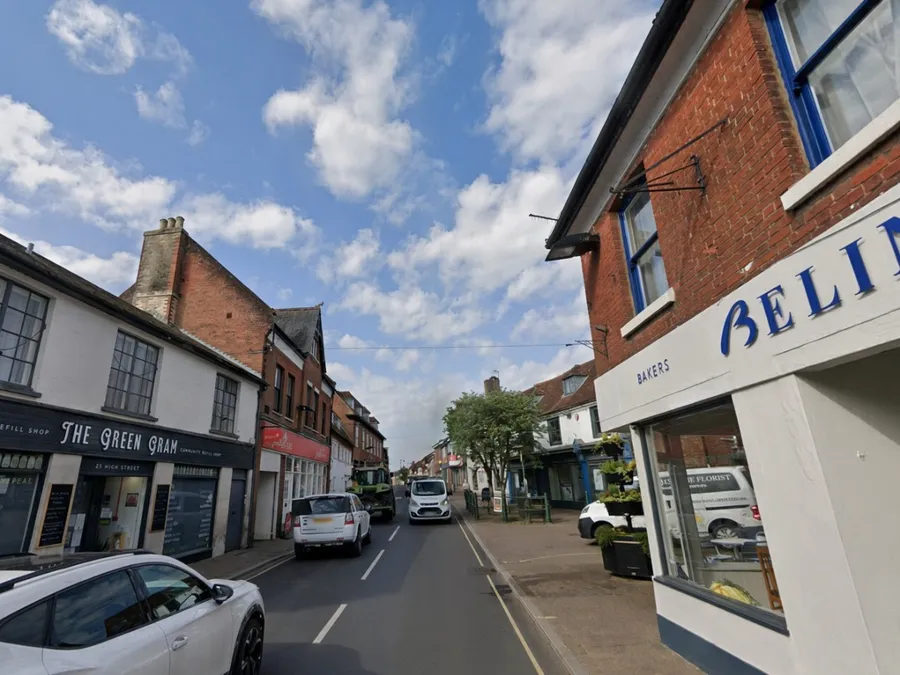
The town centre has been dying a slow death. Part of that is national retail change. A large part, locally, is the volume of traffic forced through streets built for horses and carts. The queue often starts with something smaller than a lorry: a driver parked on the kerb, turning a two-way street into a single lane until the tailback reaches the mini-roundabout.
Residents blame parking charges. The town-centre car park is well used. New Forest District Council also runs a parking clock that works out at less than a pound a day across a list of sites. Those two facts can both be true at once. The car park and the clock do not stop someone dumping a vehicle on Salisbury Street. That is a different problem, and it is the one that creates the pinch.
This is a reading of council papers, the Town Design Statement, conservation-area text, Town Council minutes and local reporting. It is not a highways design. Hampshire County Council is the highway authority. New Forest District Council runs the car parks. Fordingbridge Town Council can lobby. It cannot paint lines or switch on signals.
Why the traffic has nowhere else to go
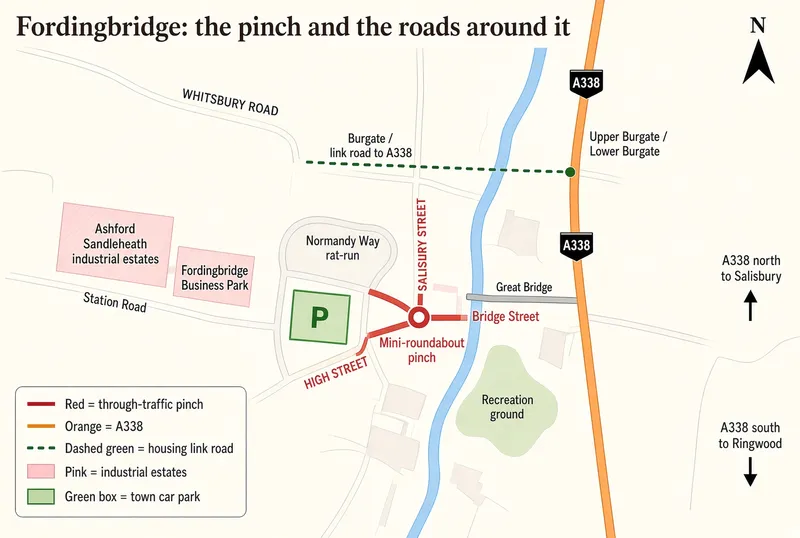
Fordingbridge exists because of the Avon crossing. There has been a bridge here since at least the thirteenth century. The seven-arch Great Bridge still pours east-west movement into the same tight streets. Employment on the western side of town, at the business park and the Ashford and Sandleheath industrial estates, needs a route to the A338 on the eastern side. The historic core is that route.
The conservation-area appraisal called this the principal environmental problem in Fordingbridge: heavy and commercial traffic funnelled through the centre, with no other sensible through-route. It said there were no sensible and supportable solutions, and that the Local Plan accepted the conflict was likely to remain unresolved. Minor works to make life more bearable for pedestrians were all it offered.
That sentence is why later arguments feel circular. New houses add trips. The model is often judged “within capacity”. The lived experience is still two lorries that cannot pass, a bus that clips a shopfront, and a pavement 28 centimetres wide on parts of Salisbury Street.
The complaint is not new
The Fordingbridge Town Design Statement is still the clearest local diagnosis. It recorded delivery vehicles jamming High Street and Salisbury Street, buses and large vehicles struggling to turn from Bridge Street into Salisbury Street, parking on both sides of Park Road, and two heavy vehicles that could only pass by mounting the pavement.
Pedestrians, particularly older people and those with young children, felt intimidated. Listed buildings shook. Visitors told the consultation they were afraid of coming into town because wing mirrors overhung the footway.
The Design Statement said the official response had been resignation to an intractable problem. If nothing was done, it warned, the problem would solve itself because trade would fall as the town became less attractive to shop and do business in.
In August 2013 a woman was hit on the head by a lorry wing mirror on the High Street. The Fordingbridge Society petitioned the town, district and county councils the following year. Society president Dr Edgar Moss said two lorries could not pass without mounting the pavement, and that even a scrape-past had hurt people.
Mayor Malcolm Connolly said the roads were becoming more dangerous because they were too narrow for the traffic. The Daily Echo reported the petition and the call for HGVs to be steered off the High Street, plus a new road from the Whitsbury side to the A338 if more housing went ahead.
A 2020 town survey found 74 per cent of residents rated the roads poor or very poor. Pavements damaged by lorries mounting them came up again. People felt neglected by the county and the district.
The Town Council’s 2022 strategic plan put traffic, HGVs, speeding, parking and the state of roads and footways at the top of public comment. Higher-tier councils had only recently agreed to resource an Access Strategy. The council’s own list was a 20 mph limit for the main town, extra traffic calming, better maintenance, and public-realm work that might extend pedestrian areas. It did not claim a funded one-way scheme.
The same complaints are still arriving at the council table. On 1 October 2025 a resident asked for action on cars parked along Salisbury Street blocking the flow. A restriction already exists from 8am to 6pm. It is not kept. The minutes record four actions: report contraventions on the Hampshire site, report faded lines, ask for more traffic-warden visits, and request a sign pointing drivers to the car park.
In December 2025 a bus clipped the chemist at the mini-roundabout, closed Salisbury Road, and police noted drivers ignoring temporary traffic control. Westacres residents brought a decade of speed-camera data to the January 2025 meeting: most vehicles over 30 mph in a 30 limit, some over 40, one at 67 near school time. They expected the new link road to make rat-running worse without enforcement.
What has been proposed
A one-way system
This is the measure residents reach for, and it is not a new idea. The Town Design Statement asked Hampshire County Council, as a first step, to run a feasibility study into a one-way system to reduce the pressure of heavy traffic through the town centre.
No published county study has then designed, costed and consulted a High Street and Salisbury Street one-way with signals at each end. Asked for is not the same as commissioned.
A one-way with lights at each end would turn two-way conflict into sequenced platoons. It could stop the two-lorry deadlock. It could free a strip of carriageway for a wider footway or a loading bay. Parking on the pinch would matter less, because oncoming traffic would not be trying to squeeze past.
It would also move the problem. The Great Bridge and the mini-roundabout still have to swallow the same volume. Displaced traffic will hunt Normandy Way, Provost Street, Station Road and Whitsbury Road. Buses and deliveries still need a legal path. Signals add delay even when the street is empty. The conservation area and the listed frontages limit how much you can widen or hang kit on.
The honest next step is the study the Design Statement already requested, then a temporary trial with queue-length counts, not a permanent scheme drawn on the back of an envelope.
The A338 link road
This is the nearest the town has come to a structural fix, and it is tied to housing, not to a standalone bypass budget.
Local Plan sites around Burgate, Whitsbury Road and Augustus Park were planned with a new road connecting Whitsbury Road to the A338 north of the town. Planning conditions have required that link, including the A338 roundabout, before later occupations. Officers have described it as allowing traffic to bypass the town centre and relieve the pinch.
It is not a ring road. It mainly serves the new estates and some west-east movements that currently have no choice but the High Street. It will not stop A338 traffic that wants the shops. It will not take industrial-estate lorries off Salisbury Street unless the county also adds a signed HGV route.
Town Council minutes in late 2025 still worry about when the roundabout and the through-road actually open relative to occupations. Delivery timing is the live issue, not the concept.
20 mph and calming
The Design Statement recommended 20 mph along Salisbury Street, Bridge Street, High Street, Provost Street, Church Street and Shaftesbury Street. The 2022 strategic plan restated a 20 mph limit for the main town. The safety case is the narrow footway and the wing-mirror overhang.
A painted 20 without enforcement or physical calming will not unblock a pinch caused by parked cars and two-way HGVs. It can reduce the violence of the conflict and the shaking of listed walls.
Parking charges, the clock, and the kerb
These are three different arguments.
On-street parking on the pinch is a traffic-flow problem. The existing 8am to 6pm restriction on Salisbury Street, fresh lining, a loading ban at the worst spots, a sign to the car park, and more civil-enforcement visits are the cheap tools. The Town Council is already asking for them.
Car-park charges are a high-street argument. Traders have said for years that charges send shoppers to Ringwood, where Waitrose parking is free. In 2017 the owner of Timothy’s put that to the Town Council after the banks left and the High Street emptied. In 2025 the Town Council wrote again to NFDC asking for one hour free, noting that Fordingbridge has no free parking unlike some other district towns. In December 2025 The George began reimbursing up to two hours’ parking to get people through the door.
The parking clock is real and cheap for residents who use the listed NFDC sites. It does not make a visitor’s first hour free. It does not ticket the car on Salisbury Street.
A busy town-centre car park does not disprove the pinch. Those are different spaces. The off-street car park is where you want the shopper. The kerb on a two-way historic street is where the tailback starts.
Access Strategy without a cheque
The Town Council’s March 2026 response to the Local Plan consultation was blunt. Hampshire’s Access Strategy and the draft walking and cycling plan are full of improvement ideas with no funding attached. Growth has already outpaced infrastructure. Further expansion east of the A338 would add traffic without a credible crossing or a town-centre traffic-management plan.
On individual housing applications the Highway Authority has often concluded the town-centre network would still operate within capacity. The Town Council has pointed to conflicting comments on the same Bridge Street mini-roundabout: an earlier note that it would breach capacity and that extra traffic would be severe, then a later note that it would stay within capacity into the 2030s. That gap between the model and the queue is why people stop trusting the paper.
What can actually be done
Stricter parking enforcement is the one lever that does not need a new road. The restriction already exists. The lines have faded. Wardens are infrequent. Report the car, report the lines, keep asking for visits. That is unglamorous and it is the closest thing to an immediate fix.
A first free hour in the town car park is a vitality measure. It will not clear Salisbury Street on its own. It may stop some of the “I only needed five minutes” kerbside stops if the off-street option feels cheap enough.
A 20 mph limit on the historic core is already written into local documents. It needs the county to make the order.
A one-way trial with signals is the Design Statement request that has never had a public answer. The county can model it. A temporary traffic order can test it. Displacement onto residential streets has to be part of that test, not an afterthought.
Finish the A338 to Whitsbury link and keep construction traffic off the High Street. That is already a planning obligation. Watch the occupation trigger, not the artist’s impression.
A full town bypass is not on anyone’s funded list. The floodplain, the conservation area and the cost are why the conservation appraisal called the structural conflict unresolved.
None of that will reverse every empty unit. Traffic is not the only reason a small New Forest town loses shops. It is the reason two lorries still mount the pavement on a street of listed houses, and why a parked car can freeze the centre for twenty minutes. Those are problems with owners: Hampshire for the carriageway, the district for the car parks and the tickets, and drivers for the kerb.
Key sources
- Fordingbridge Town Design Statement, New Forest District Council. Traffic diagnosis, 20 mph recommendation, and the request that Hampshire study a one-way system.
- Fordingbridge conservation area appraisal. Volume of through traffic as the principal environmental problem, and the line that the Local Plan accepted the conflict as likely to remain unresolved.
- Daily Echo, 11 December 2014. Fordingbridge Society petition after the August 2013 wing-mirror injury, HGV conflict on the High Street, listed buildings.
- Fordingbridge Town Council Strategic Plan, August 2022. Traffic and HGV concerns, Access Strategy, 20 mph and calming priorities.
- Fordingbridge Town Council General Council minutes, 1 October 2025. Salisbury Street parking complaint, 8am-6pm restriction not kept, request for wardens, lining and a car-park sign.
- Fordingbridge Town Council General Council minutes, 8 January 2025. Westacres speeding data and concern that the link road will worsen rat-running without enforcement.
- Fordingbridge Town Council response to the NFDC Local Plan Regulation 18 consultation, March 2026. Access Strategy and LCWIP unfunded, A338 severance, cumulative traffic of further growth options.
- New Forest District Council planning committee reports on Burgate / Whitsbury Road / Augustus Park sites, 2023-24. Link road to the A338 described as a town-centre bypass for that traffic, occupation trigger for the road.
- Bournemouth Echo, 19 December 2025. Bus striking the chemist at the mini-roundabout.
- New Forest District Council parking clock page. Resident clock scheme for listed car parks.
- Daily Echo, 19 November 2020. Town survey: 74 per cent rated roads poor or very poor.